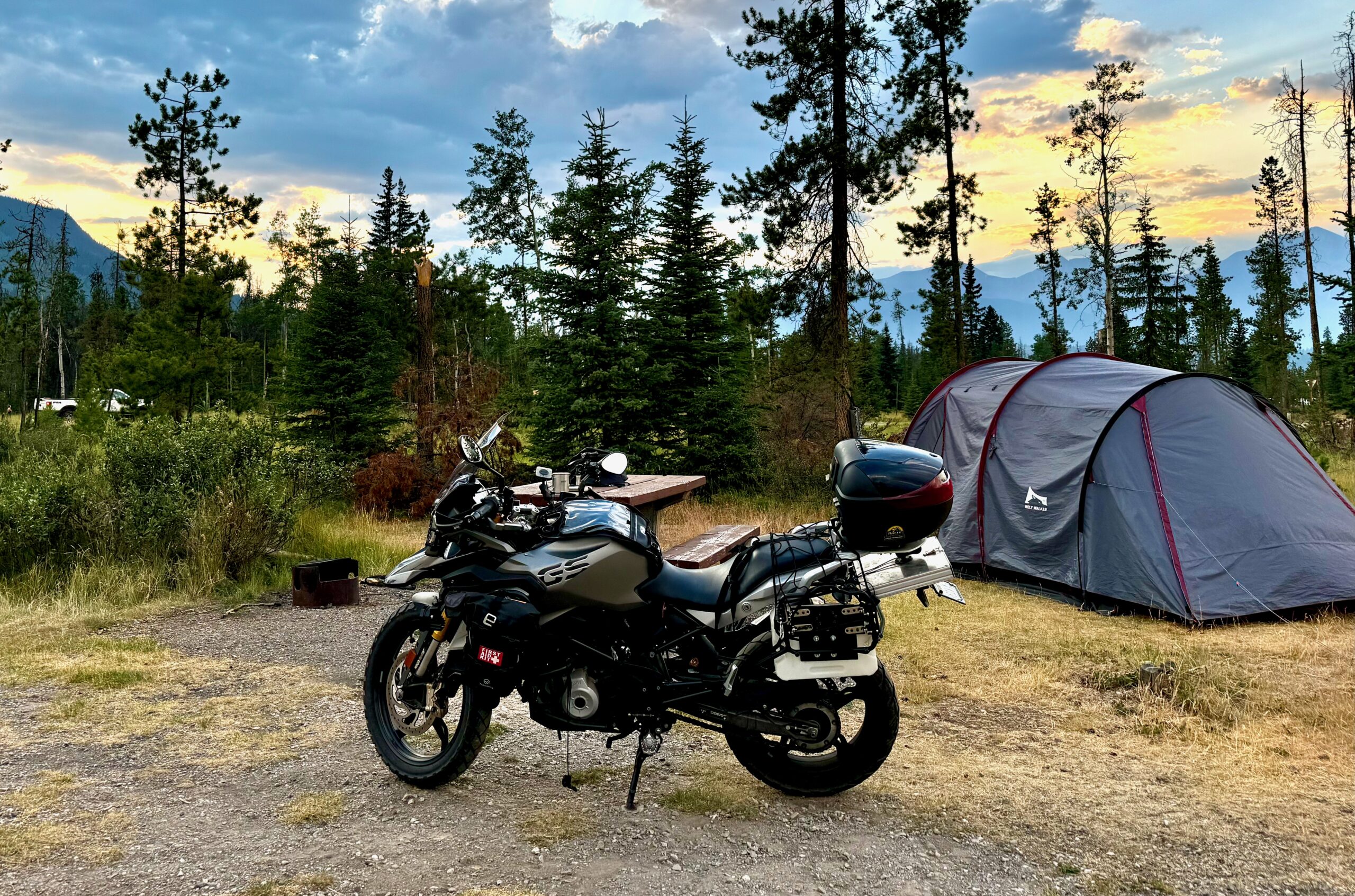
In July 2024, I rode a small motorcycle from Texas toward the Arctic Ocean. The trip was about grief, motion, and what happens when you stop waiting for conditions to be perfect. I’m writing a book about it. This newsletter is where I’ll share pieces of that story as I finish it.
On July 22nd, wildfire forced the evacuation of Jasper, Alberta—25,000 people fleeing through smoke and gridlock. I was one of them. A ranger pointed me to a service road that bypassed the convoy, and I escaped north into the mountains alone. What I rode into was more dangerous to me than what I’d left behind.
Ten Meters at a Time
The drizzle started light, almost a relief after the heat and smoke. It felt like a reset—clean air, the smell of smoke washing away. For maybe ten minutes I let myself believe this was manageable. Just rain. I’d ridden in rain before.
Then it changed.
The drops got heavier, colder. Wind gusts started hitting from unpredictable angles. I watched the road ahead darken as the storm cell moved down the valley toward me, a gray wall swallowing everything in its path.
Within minutes it turned violent.
Rain came hard, driven sideways by wind funneled through the mountain corridor. My headlight scattered across the wet pavement, the road flashing silver as water pooled in low spots. The yellow centerline vanished under the runoff. I eased back from sixty to forty, then thirty, feeling for traction with every small correction of the bars.
Lightning ripped the sky open. Not distant or harmless, but close and immediate. Each flash froze the forest in stark white before throwing it back into blackness. Thunder followed instantly, a deep, physical thud that felt like a fist to the chest. Gusts of wind hit the bike from alternating sides, shoving me toward shoulders that barely existed.
The forest pressed close, walls of black on both sides, broken only by the occasional reflector catching light. There were no guardrails, no margin for error. Just road, then drop, then trees. Any mistake here wasn’t going to mean a bruise or a story—it would mean gone.
Progress became math—ten meters at a time. Pick a point in the headlight beam, reach it, pick another. The bike became the entire world. Throttle, brake, lean angle, traction. Each input mattered. Every mistake carried potential consequences.
Fear came slowly at first, then all at once.
It started as awareness. The mental calculation of risk versus capability. I was alone. The road was empty. Help was hypothetical. These were just facts, manageable facts.
Then my body took over.
It wasn’t the manageable kind of fear—the sharpened reflexes that keep you alive. It was deeper, heavier. It got inside my breathing. My arms stiffened, hands gripping too tight, muscles refusing to relax. I tried to force calm, but adrenaline overruled logic.
I started bargaining with myself. Just get to McBride. Just make it through this section. Just keep the bike upright. The negotiations got smaller as the storm got worse. Just make it through the next curve. Just keep the wheels on pavement. Just don’t die here.
The promise to my kids wasn’t abstract anymore. It was a physical presence in the helmet with me, louder than the thunder. I could see their faces between lightning flashes—not as memory but as something immediate, like they were watching. What would it mean for them if I didn’t come home? Not philosophy. Actual logistics. Who tells them? How do they hear? What’s the last thing I said before I left?
I could feel my own limits closing in.
Men are taught early to fight that feeling. To rename fear. Call it focus. Call it grit. Pretend it’s not there. But in that storm, the truth was simple. I was terrified. I knew the cost of one mistake. Gravel. A deer. A blind corner. Invisible pothole. A split-second of doubt. None of it forgives you out here.
The rain got heavier. It pounded the helmet so hard it blurred the edges of sound. My shoulders locked. My jaw clenched. I tried to relax my hands but couldn’t. The visor fogged from inside; I cracked it open, taking the sting of the rain to stay alert.
Stopping wasn’t an option. Not here. Not on a narrow mountain road with no shoulder and no visibility. The only way out was forward. Ten meters at a time.
Time stopped making sense.
I checked the odometer: 23 kilometers since the junction. It felt like a hundred. I checked again what seemed like an hour later: 27 kilometers. Four kilometers. Maybe ten minutes had passed. Maybe thirty. The clock on the dash showed numbers but they meant nothing.
Every curve took forever. Every straight stretched into infinity. I’d spot a reflector ahead, aim for it, reach it after what felt like miles of riding, only to find it was fifty meters back. Distance collapsed. Time expanded. The storm created its own physics.
The fuel gauge dropped toward empty, the needle flickering in the red. That tiny indicator hit harder than any thunderclap. If I ran dry, there’d be no place to wait it out. Just a stalled bike, invisible in the storm. Numbers I could trust. The GPS had long since failed to update. Kilometers remaining: maybe sixty. McBride distance: unknown. The math refused to work in my favor.
I caught myself whispering small deals into the helmet. Just a little farther. Let the tires hold. Don’t let the light die. Promises to no one. The storm stripped everything down. No philosophy, no adventure, no bravado. Just endurance. Just survival.
A bolt hit close enough to shake the air.
The flash came first. Not light in the sky but light everywhere, inside the helmet, behind my eyes, like the world’s exposure blown to pure white. The sound followed a microsecond later, not thunder but detonation, a physical force that hit my chest and rattled teeth.
For an instant I was blind. No up, no down, no horizon. Just white. Then afterimages, purple ghosts swimming across my vision. The road should have been there, but I couldn’t see it. Was I still pointing straight? Had I veered into the oncoming lane? Was there a cliff? A tree?
I had no idea if I’d drifted off the road until the front wheel found traction again. Pavement, rumble strip, pavement. I’d been weaving. How long had I been blind? A second? Three seconds?
The mantra kept looping. Throttle, brake, lean angle, traction. A litany. A heartbeat.
And then, gradually, the rhythm shifted. The rain thinned to thick drops. The wind lost some of its teeth. The thunder began to fade, not gone, just distant—like something finally finished with me.
Through the rain-smeared visor I caught it. A faint glow on the horizon. At first it looked like a mirage. Then it steadied into something real. Actual streetlights, gas station signs, the edges of buildings. Civilization.
Ten more meters. Then ten more. The glow became a town. McBride.
I rolled into the first gas station on fumes, the fuel light flashing red. My hands were too stiff to pull in the clutch cleanly. My legs shook when I tried to stand. For a long moment I just sat there, engine idling, helmet dripping, lungs pulling air like I hadn’t breathed in hours.
The station attendant stepped out under the awning, jacket zipped tight against the last of the rain. He looked at me for half a second and read everything that didn’t need saying.
“Evacuee?” he asked.
I hadn’t thought of myself this way until this moment, but yes. I nodded, finally finding words. “Yeah. From Jasper.”
He pointed across the street toward a brick building glowing under floodlights. “Firehouse. They’ve got people set up there. Go on in. You’ll be safe.”
Safe. The word barely registered, but I followed it. Crossed the street, the tires slapping against puddles, the engine sputtering in relief.
I parked beneath the awning of the firehouse and shut the bike down. The silence felt enormous. The storm was still moving north, but it had left me behind. For now, that was enough.
From “Throttle On: Unstuck on the Way to the Arctic Circle,” forthcoming 2026.